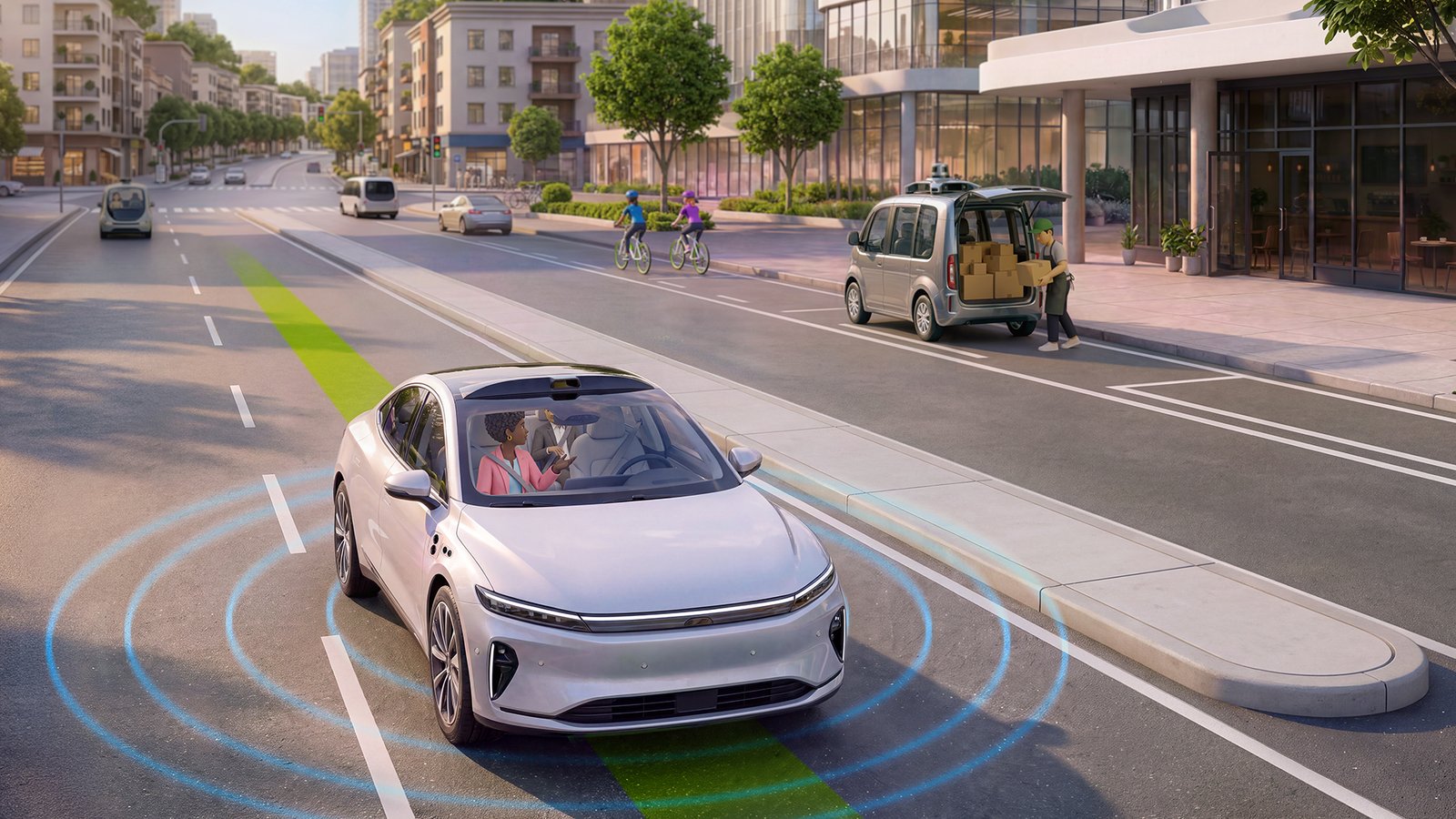
The Ghost in the Machine: The Dawn of the Robotaxi Era
For years, the dream of autonomous transport felt like a distant mirage—a high-tech fantasy relegated to experimental test tracks and sanitized suburban neighborhoods. But the horizon has shifted. We are no longer just watching prototypes navigate empty streets; we are witnessing the birth of physical AI. The robotaxi market is no longer a niche curiosity for Silicon Valley enthusiasts, but a projected $400 billion economic powerhouse by 2035. As driverless fleets begin to weave through some of the world’s most chaotic urban arteries, the gap between “experimental” and “essential” is closing with staggering speed.
The transition from a single prototype to a massive, scalable fleet introduces a grueling set of engineering hurdles that software alone cannot solve. To move millions of people safely, a vehicle must not only “see” its surroundings but interpret them in real-time with superhuman consistency. This requires a massive leap in compute power and architectural reliability. The infrastructure supporting these vehicles must be robust enough to handle the unpredictability of human behavior, erratic weather conditions, and the chaotic geometry of modern city planning. Scaling is where many startups fail, yet the leaders are finding a path forward.
At the heart of this technological revolution lies a massive shift toward physical AI. Unlike standard generative AI, which processes symbols and text, physical AI must interact with the laws of physics in three-dimensional space. This demands a specialized stack where high-performance computing meets real-time sensor fusion. To achieve this, industry leaders are gravitating toward unified platforms that can process massive amounts of data from cameras, lidar, and radar simultaneously. The goal is to create a system that doesn’t just react to an obstacle but predicts the intent of every pedestrian and cyclist in its vicinity.
NVIDIA has emerged as the foundational architect for this shift, providing the heavy-duty machinery required to power these complex neural networks. By offering a full-stack open platform, they enable developers to move from training models to deploying them on the road without constant friction. This ecosystem allows engineers to focus on the nuances of driving logic rather than the minutiae of hardware optimization. According to a recent source report, this unified approach is what allows top players to scale their operations from dozens of cars to thousands of vehicles across diverse geographic regions.
The complexity of the task cannot be overstated. A robotaxi must perform millions of calculations per second just to navigate a single city block safely. This requires specialized hardware that can handle the immense “compute tax” imposed by high-resolution spatial mapping and deep learning models. By leveraging advanced GPU architectures, companies are able to train their fleets on massive synthetic datasets while maintaining low-latency execution in live environments. This synergy between sophisticated silicon and intelligent software is what ultimately determines whether a car becomes a reliable public utility or remains a dangerous experiment.
As the industry matures, the focus is shifting toward “generalizable” intelligence. The goal is to create a system that can learn the rules of the road in one city and adapt them instantly to another without needing a complete rewrite of its codebase. This level of adaptability is only possible when the underlying platform provides a consistent framework for data ingestion and model deployment. By standardizing the way these machines perceive their world, the industry is moving toward a future where the “driver” is an invisible, flawless layer of software designed to navigate our physical world with total precision.
The Edge Case Gauntlet
While high-speed highways and predictable lanes are the early training grounds, the true test of autonomous intelligence lies in the “edge cases”—the unpredictable variables of human existence. A child chasing a ball into the street, a construction worker waving erratic hand signals, or a sudden torrential downpour that obscures lane markings are scenarios where standard algorithms often stumble. To conquer these, developers are moving beyond simple rule-based programming toward end-to-end neural networks. These systems do not just follow a script; they learn to infer intent and predict behavior. By processing millions of miles of recorded human driving data, the machine begins to recognize patterns in chaos, turning unpredictable moments into solvable mathematical problems.
However, this leap toward more autonomous “reasoning” brings significant technical risks. When a vehicle makes a split-second decision, the logic behind that choice must be transparent and verifiable. The industry is currently grappling with the “black box” problem of deep learning, where even the engineers may not fully understand why an AI chose a specific maneuver in a crisis. To mitigate this, companies are layering symbolic AI over neural networks to create safety guardrails. This hybrid approach ensures that while the machine can navigate the nuances of a crowded city, it remains bound by hard-coded safety protocols that override any “creative” interpretations of traffic laws or physics.
Related Articles
The Infrastructure of Autonomy
Scaling these fleets requires more than just smarter cars; it demands a fundamental overhaul of urban infrastructure. We are entering the era of V2X—Vehicle-to-Everything communication. In this vision, traffic lights, road signs, and even pavement sensors communicate directly with the fleet via 5G and dedicated short-range communications. This creates a redundant safety net where the car is no longer an isolated island of intelligence but part of a synchronized ecosystem. By digitizing the physical world, cities can optimize traffic flow in real-time, reducing congestion and emissions. The goal is to move from reactive driving to proactive navigation, where the road itself provides the data necessary for flawless execution.
The economic stakes of this infrastructure shift are monumental. Logistics companies are already eyeing the massive cost savings of “middle-mile” autonomous trucking, while ride-hailing giants aim to slash overhead by removing the human driver from the loop. This transition promises a democratization of mobility, potentially providing transportation for those unable to drive due to age or disability. Yet, it also threatens the livelihoods of millions of professional drivers. The transition period will be volatile as labor unions and local governments debate how to manage this displacement. The shift is not just technological; it is a profound restructuring of the labor market and the very fabric of urban mobility.
The Final Frontier: Trust and Policy
Ultimately, the success of the robotaxi revolution hinges on public trust. A single high-profile accident can set the industry back by years, leading to restrictive regulations that stifle innovation. To succeed, developers must move beyond “it works most of the time” to “it is demonstrably safer than a human.” This requires rigorous certification and standardized safety metrics across all manufacturers. As we stand on this precipice, the question is no longer whether the machines can drive, but whether we are ready to let them take the wheel in our daily lives. If the ghost in the machine can finally master the complexities of our streets, how will we redefine our relationship with the road?