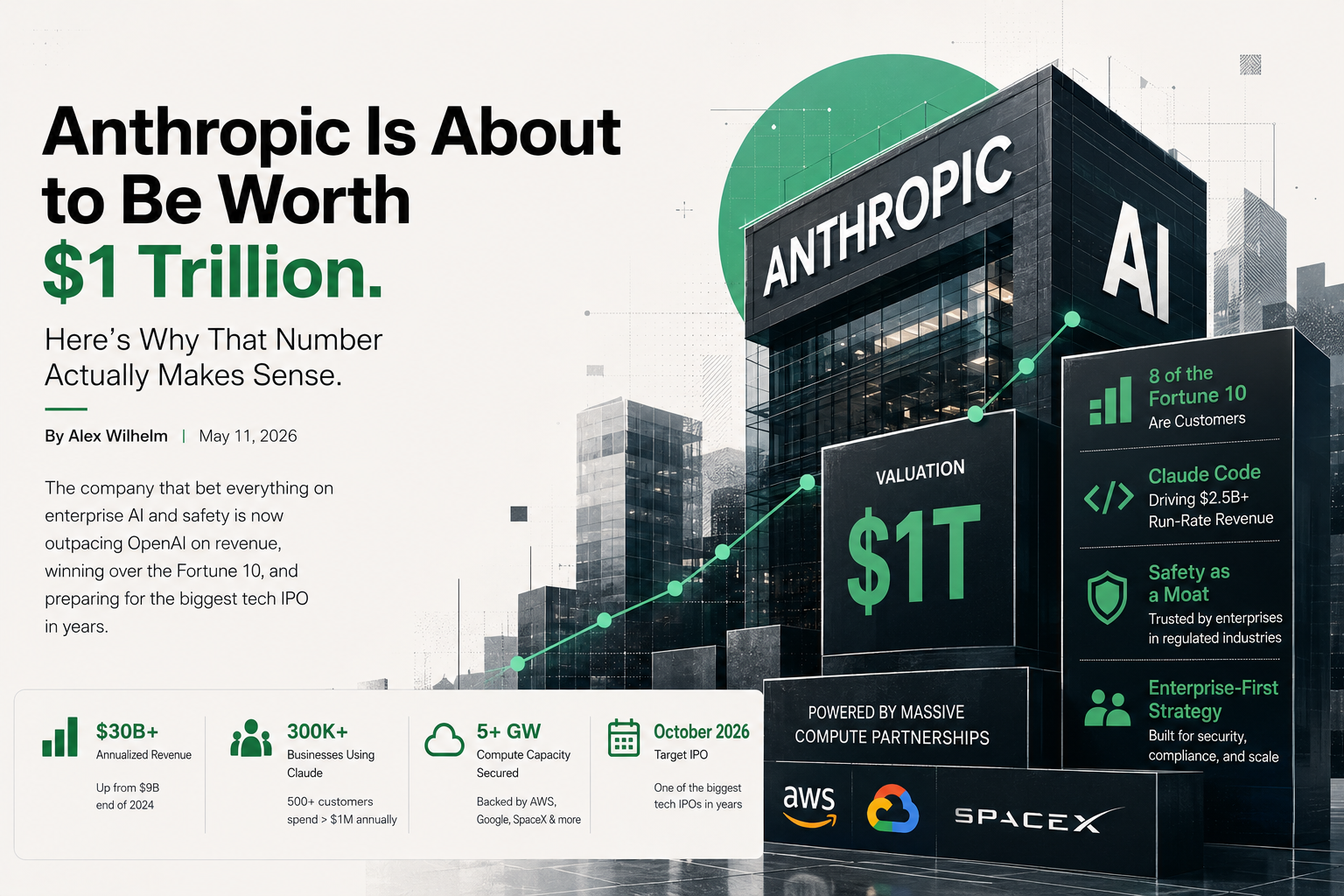
The company that bet everything on enterprise AI and safety is now outpacing OpenAI on revenue, winning over the Fortune 10, and preparing for the biggest tech IPO in years.
By AIChain Tech| May 11, 2026
Three months ago, Dario Amodei’s company was worth $380 billion. That was already the second-largest private fundraising round in history. Today, secondary market traders are pricing Anthropic at north of $900 billion — and some transactions are clearing at $1 trillion. For context: that’s more than Netflix, more than Tesla, and roughly equal to the GDP of the Netherlands.
The speed of this is almost impossible to process. Anthropic went from a $60 billion valuation at the start of 2025 to flirting with a trillion dollars eighteen months later. That’s a 15x increase. Google took six years after its IPO to reach the same milestone. Meta needed more than a decade.
So what’s actually happening here? Is this peak AI bubble, or is something real going on underneath the hype?
The answer, frustratingly, is both. And the distinction matters a lot.
The Revenue Is Real
Let’s start with the number that shuts down most of the bubble arguments: Anthropic’s annualized run-rate revenue hit $30 billion in March and April 2026, according to reporting from Reuters. That’s up from $9 billion at the end of last year. The Financial Times pegs the trajectory at $45 billion “shortly.”
For comparison, OpenAI — the company that essentially invented this market and still dominates the consumer space — is at around $25 billion ARR. Anthropic passed them. Quietly. Without making a single splashy consumer product announcement.
That gap is widening, not narrowing. And the reason comes down to a strategic bet Anthropic made early that the rest of the industry dismissed as boring: they went all-in on enterprise.
The B2B Play That Everyone Underestimated
When Anthropic launched Claude, the narrative in the AI press was almost uniformly condescending. OpenAI had ChatGPT, the cultural phenomenon. Google had Gemini, backed by the most powerful distribution machine in tech history. Meta had Llama, with an open-source strategy that could undercut everyone on price. What did Anthropic have? A chatbot named after a literary device, and a CEO who kept giving interviews about existential risk.
What Anthropic actually had was a thesis: that the real money in AI wasn’t going to come from consumer subscriptions. It was going to come from enterprises — big ones, serious ones, ones with legal teams and compliance departments and CISOs who needed to sign off on every vendor relationship. Anthropic decided to be the AI company those organizations could actually trust.
That thesis is now printing money.
Eight of the Fortune 10 are Claude customers. More than 300,000 businesses use Anthropic’s products. Over 500 customers are spending more than $1 million annually — that number was 12 two years ago. The cohort spending more than $100,000 a year has grown sevenfold in twelve months. These aren’t pilot programs anymore. This is production infrastructure.
Claude Code Changed Everything
If you want to understand why Anthropic’s revenue went from $9 billion to $30 billion in roughly four months, the answer is mostly one product: Claude Code.
Launched in public beta in May 2025, Claude Code is an agentic coding tool — meaning it doesn’t just suggest code, it actually executes tasks, navigates codebases, runs tests, and ships changes. In the enterprise context, it solves the problem that was quietly killing AI adoption in engineering teams: you can’t babysit an AI agent in a production environment at 2am when something breaks.
By February 2026, Claude Code’s run-rate revenue had crossed $2.5 billion. Business subscriptions had quadrupled since January 1st. Weekly active users doubled in the same window. Claude Code now accounts for more than half of all Claude Code revenue from enterprise customers.
This wasn’t an accident. Anthropic had been quietly solving the reliability problems that made agentic AI unusable in production. The April 2026 release — which the company says addresses the hardest remaining problem in the agent stack — appears to have unlocked another wave of enterprise adoption. Competitors have spent years promising “AI agents for software development.” Anthropic shipped one that actually works at scale.
The Infrastructure Behind the Numbers
A $1 trillion valuation is also, in part, a bet on compute. And here, the numbers are staggering.
Amazon Web Services has committed up to $25 billion and 5 gigawatts of compute capacity. Google — which confirmed a $40 billion investment on April 24th — has committed another 5 gigawatts. Anthropic recently added SpaceX to its compute partnership roster for additional near-term capacity.
This is the understated part of the Anthropic story. The company isn’t just winning customers; it’s winning the infrastructure partnerships that determine who gets to train the next generation of frontier models. When the cost of training a cutting-edge model runs into billions of dollars, having guaranteed compute from the world’s largest cloud providers isn’t a nice-to-have. It’s an existential advantage.
The proposed $50 billion round — which TechCrunch describes as likely Anthropic’s final fundraise before a potential October 2026 IPO — is primarily about one thing: buying more compute directly, beyond what strategic partners have already allocated.
Safety as Competitive Moat
Here’s the part that still surprises people who’ve been watching AI from the outside: Anthropic’s safety positioning is actually generating revenue.
The company operates as a Public Benefit Corporation with its Responsible Scaling Policy — a public commitment to only deploy systems that meet strict safety benchmarks — baked into its corporate structure. This isn’t PR. For a CISO at a major financial institution trying to justify an eight-figure AI vendor contract to a board of directors, it’s a material differentiator. For a hospital system operating under HIPAA, it’s a prerequisite.
Anthropic’s healthcare expansion — Claude for Enterprise now covers HIPAA-compliant use cases — opened a market that most AI companies haven’t even attempted to enter. The regulatory complexity is a moat. Anthropic deliberately built a boat to cross it.
Compare this to OpenAI’s ongoing structural saga. The company’s shift from a nonprofit to a capped-profit hybrid to (reportedly) a fully for-profit entity has generated genuine uncertainty among enterprise legal teams. Anthropic’s PBC structure is boring in exactly the right way. Boring structures close enterprise deals.
The Competitive Landscape Is Shifting, Fast
For most of 2023 and 2024, the narrative was simple: OpenAI leads, everyone else follows. That framing is no longer accurate.
OpenAI’s valuation peaked at $852 billion after a $122 billion fundraise in March 2026. It was celebrated as a historic milestone. Six weeks later, secondary market data showed Anthropic shares had appreciated 211 percent in three months. OpenAI shares were up 8.5 percent in the same window. Business Insider reported that institutional investors were struggling to find buyers for $600 million worth of OpenAI stock. Meanwhile, the demand for Anthropic allocation was so intense that, per the Financial Times and Reuters, some venture capitalists were reportedly offering personal collateral — including their homes — to secure a spot in the next round.
That’s not a normal market dynamic. That’s a regime change.
Anthropic has also made a strategic play that should terrify Microsoft: Claude is the only frontier model available on all three major cloud platforms simultaneously — AWS Bedrock, Google Cloud Vertex AI, and Microsoft Azure Foundry. For enterprises that don’t want to be locked into one hyperscaler’s ecosystem, that’s an enormous advantage. For Microsoft, which has bet heavily on OpenAI exclusivity as a competitive differentiator, it’s a problem.
What the IPO Could Mean
Goldman Sachs and JPMorgan are reportedly advising on a potential public listing as early as October 2026. At current secondary market prices, this would rank among the largest tech IPOs in history — in a year when SpaceX is also aiming for a $1.75 trillion debut.
The timing is deliberate. A public offering would cement Anthropic’s position, create liquidity for early investors, and — perhaps most importantly — establish a market-priced benchmark for what enterprise AI infrastructure is actually worth.
That last point matters beyond Anthropic. The company’s IPO would set a reference price not just for Claude, but for the entire category. Every enterprise AI startup, every competitor, every investor trying to model where this market goes next would orient around whatever multiple the public market assigns to Anthropic’s revenue.
The Honest Caveat
None of this means the $1 trillion number is bulletproof. Secondary market valuations are sentiment gauges, not audited financials. The gap between Anthropic’s last official round ($380 billion in February) and where private shares are trading today represents a premium of nearly 3x — paid by investors who are essentially betting that the public market will validate or exceed that number on IPO day.
A few things could go wrong. The compute buildout is expensive, and Anthropic is still burning significant capital to support its infrastructure ambitions. Open-source models — Meta’s Llama in particular — continue to improve rapidly and erode the price premium that frontier commercial models can charge. A regulatory environment that tightens around AI in unexpected ways could disrupt enterprise adoption timelines.
And then there’s the competitive response. Google has Gemini, a model that runs on Google’s own infrastructure and sits inside Google’s own cloud. Microsoft has both OpenAI and its own Copilot ecosystem. Neither of these companies is standing still.
The Bigger Picture
Gartner forecasts $2.52 trillion in worldwide AI spending in 2026 — up 44 percent year-over-year. That number is almost certainly understated, because it was modeled before Claude Code’s adoption trajectory became visible to the public.
What Anthropic has demonstrated, at scale and with real revenue data, is that the enterprise AI market doesn’t just exist — it’s voracious. Companies aren’t experimenting with Claude anymore. They’re rebuilding core workflows around it. Eight of the ten largest companies in the world are customers. That’s not a trend. That’s infrastructure.
Dario Amodei left OpenAI in 2021 with a theory: that you could build the most capable AI systems in the world and do it safely, and that safety would ultimately be a competitive advantage rather than a constraint. Four years later, that theory has a $1 trillion price tag.
Whether the market is right about that number, we’ll find out in October.
Additional reporting: Reuters, Bloomberg, Financial Times, TechCrunch, Business Insider, Anthropic Blog. Revenue figures are unaudited run-rate estimates. Secondary market valuations reflect sentiment, not official company valuation.